
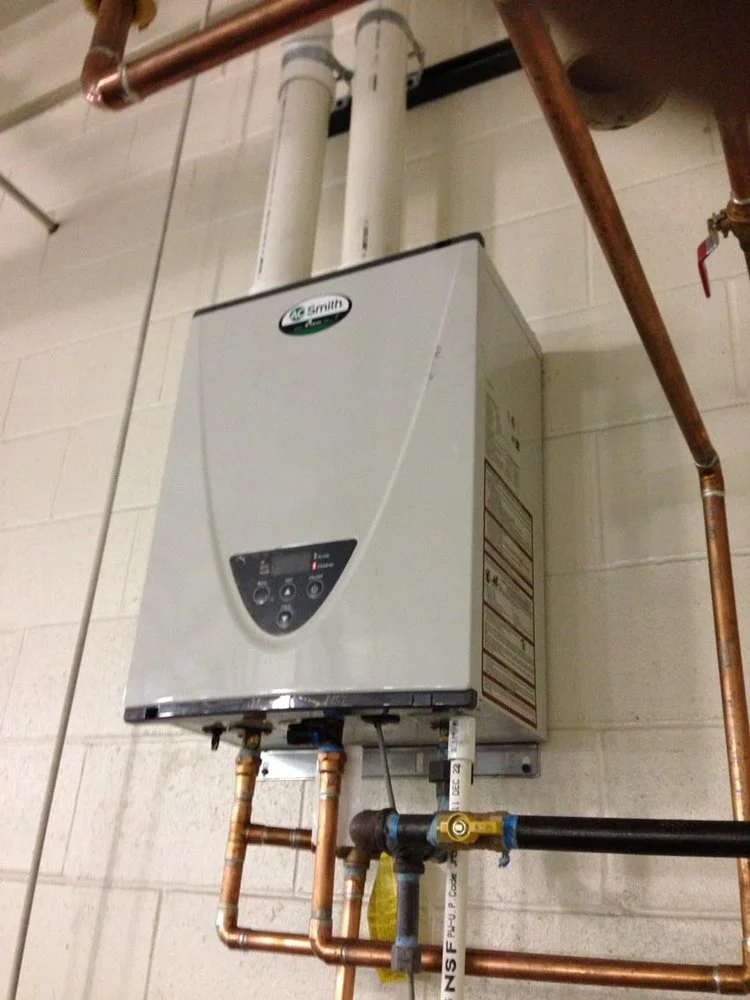
Walk the attic of a typical Bee Cave two-story and you'll often find the water heating strategy the builder chose for speed: two 50-gallon tanks, one per wing, parked on platforms above the bedrooms. It works — until the math of two aging tanks in Hill Country water starts running, and the homeowner starts asking whether the replacement round should be two more tanks, one big tankless, or two small ones. The answer depends on numbers most quotes don't volunteer, so here they are.
Per tank, a code-complete 50-gallon gas replacement in the Bee Cave area runs $1,500–$2,600 — attic installs sit at the top of that range because everything (drain pan, expansion tank, the haul up the ladder) costs more above the ceiling. Gas tankless runs $2,000–$3,500 installed when gas supply and venting cooperate, $3,500–$6,500 when they don't; a tankless burner needs roughly four to five times the gas flow of the tank it replaces, and the line upgrade is $500–$1,000 when required. The two-tank house changes the arithmetic in tankless's favor: replacing a pair of tanks costs $3,000–$5,200, which is squarely in range of one well-sized high-GPM tankless — one gas line, one vent, one annual service instead of two of everything.
Operating savings are real but modest — call it $8–$15 a month per displaced tank, from eliminating standby losses. Lifespan is where the technologies separate: 20+ years tankless against 8–12 for a tank, and in Bee Cave's water the tank figure trends toward the low end without protection. Over twenty years the two-tank house buys four tanks or one tankless (plus maintenance); framed that way, the premium mostly evaporates.
Bee Cave sits on some of the hardest water in the metro — limestone country, minerals to spare — and hardness is harder on both options than most owners expect. Tanks accumulate sediment fast enough that the low end of the lifespan range is earned, not hypothetical. Tankless heat exchangers scale until the unit errors out, making the $150–$250 annual descale non-negotiable rather than nice-to-have. The practical read: in this water, tankless without a softener is a maintenance subscription, and tankless with one is a 20-year appliance. Most Bee Cave installs that owners end up happy with pair the two — the softener also rescues the glass shower doors, which around here is its own quality-of-life category.
The two-tank attic layout puts a thousand pounds of hot water above the drywall of the rooms people sleep in. Tanks fail from the bottom, quietly, and the emergency pan is a defense that works exactly as well as its drain line is clear. A wall-hung tankless holds a cup or two of water and retires that scenario — for attic-tank houses this is the strongest single argument in the comparison, worth more than the efficiency line. If you keep tanks up there, have the pan, drain, and shutoff tested at every service — and know where the water main valve is before you need it.
Sizing is the whole game — gas line, vent path, GPM demand. Beaver matches Bee Cave homeowners with a licensed, vetted plumber who quotes both options in one visit, free.
Endless hot water is rationed by gallons-per-minute, and the big-house failure mode is an undersized unit: master rain head plus a kids' bath plus the dishwasher is 6–8 GPM of simultaneous demand, and winter groundwater in the 50s cuts every unit's effective output. Houses with real simultaneous load spec either one large condensing unit (199k BTU class), two smaller units zoned by wing, or a tankless-plus-recirculation design that also kills the long wait for hot water at the far master — a complaint that's practically a Bee Cave anthem given the square footage. This is why the sizing visit, not the brand, decides whether tankless feels like magic or like a downgrade.
Condensing gas tankless qualifies for the federal 25C credit — 30% up to $600; a standard tank never does. Utility and manufacturer promotions rotate seasonally, so make the installer produce the current list at quote time rather than trusting anything printed, this article included.
Timing beats technology, so read the current tanks before choosing successors. In this water the sequence compresses: rumble and pop (sediment) arrives early and loud; rusty hot water means the anode rod surrendered to the mineral load — in unsoftened Bee Cave water, anodes are consumed at nearly double the pace the manual assumes; crust and dampness at the fittings is the pre-leak stage; and with the attic layout, the stage after that involves your ceiling. Two-tank houses get one mercy: the tanks were usually installed the same week, which means they retire the same season — when the first goes, quote the second's replacement in the same visit, because it's holding the same hand.
Column one, stay with tanks: two installs at ~$2,100 each now, two more around year nine or ten (hard water working), plus twenty years of double standby losses — the column totals $8,400–$9,200 plus the higher gas bills. Column two, consolidate to one high-GPM condensing tankless: $4,500–$6,000 installed with the gas work, minus the $600 25C credit, plus descales (annual unsoftened, every 2–3 years softened) — call it $6,000–$7,500 all-in, with operating savings clawing back $2,000-plus over the span. For the two-tank attic house specifically, consolidation wins the ledger and the risk column — it's the rare case where the financial and non-financial arguments point the same direction.
Ask every bidder: What GPM at winter groundwater temperature, and what demand did you size from? (A rain head is 2.5 GPM by itself; a big house lies about its average.) What does the gas run from meter to unit require? Where does the condensate drain? (Condensing units make acidic condensate that needs a legal destination — an attic install detail that bites later.) What's the descale protocol in this water, and what does it cost? If we keep tanks: what's the code delta — expansion tank, pan, drain — on each? The installer with crisp answers is bidding a system; the one steering to financing is bidding a payment.
Keep (or return to) tanks when budget rules, occupancy is light, or a move is plausible inside five years. Go tankless when the tanks live in the attic, when you're consolidating a two-tank setup, when simultaneous demand is real, or when a softener is in the plan anyway — which in this water it should be. Get both options quoted in the same visit by the same licensed installer, insist the tankless quote itemizes gas, venting, and condensate, and settle it before the current tank settles it for you — rusty hot water and rumbling are the two-minute warning, and emergency replacements never comparison-shop well.